Healing Your Pelvic Floor With Hypermobility: Strategies That Don't Make It Worse
Part 2: The Action Plan
If you've been told to just "do your Kegels" and found it made things worse — you're not imagining it. For those of us living with hypermobility, hEDS, or HSD, calling the pelvic floor weak is a gross over-simplification. That crucial groups of muscles (with its many important jobs) is often overworked, overactive, and not properly coordinated with the other parts of the core.
The goal here isn't to correct the connective tissue issue; rather, we need to build functional strength, coordination, body awareness (a.k.a. proprioception), and pressure management with the body we have.
Summary, or tl;dr section
If you came upon this blog without reading Part 1, friendly suggestion to go back and read it before continuing on. While the first blog in this series went more in depth on what we know about the pelvic floor with hypermobility and the research, this blog focuses more on what we can do, the muscles we can target, some generic exercises to begin and how to get help if needed.
A little disclaimer before we go on: gentle reminder that this blog is solely for your information from an expert in scoliosis and pelvic health. This blog is for general information only and can not serve as medical advice. Each person will have different circumstances and you should ask your personal medical & wellness team, or you can book a consult for personalized expert advice.
Now that we’ve established the connection and the evidence behind it, I’ll be breaking down what a supportive strengthening routine actually looks like for hypermobile bodies. For those of us with hypermobility, the approach to our pelvic health has to be different, focused on a whole-body, coordinated approach. After all, we know the pelvic floor doesn’t work in isolation; rather, it’s a part of an important system that needs to work together in harmony.
So let’s dive right in…
Why breath matters for hypermobile bodies
For many people living with hypermobility, we need to employ all kinds of strategies to hold ourselves up since our bodies crave stability. When we lack the stiffness in our connective tissue, or fascia, one of the most common and easily accessible ways to get it is — perhaps you’ve already guessed it:
Breath holding.
Holding your breath is a great way to create what we call intra-thoracic pressure. That pressure is really helpful to provide that stiffness we need to do strenuous things like lift or jump, or hold ourselves up when our muscles are too tired or weak to do the job. Something that it pressurized (think a sealed soda can) is very stable.
So all that in mind, it can be a really helpful strategy to help stabilize us.
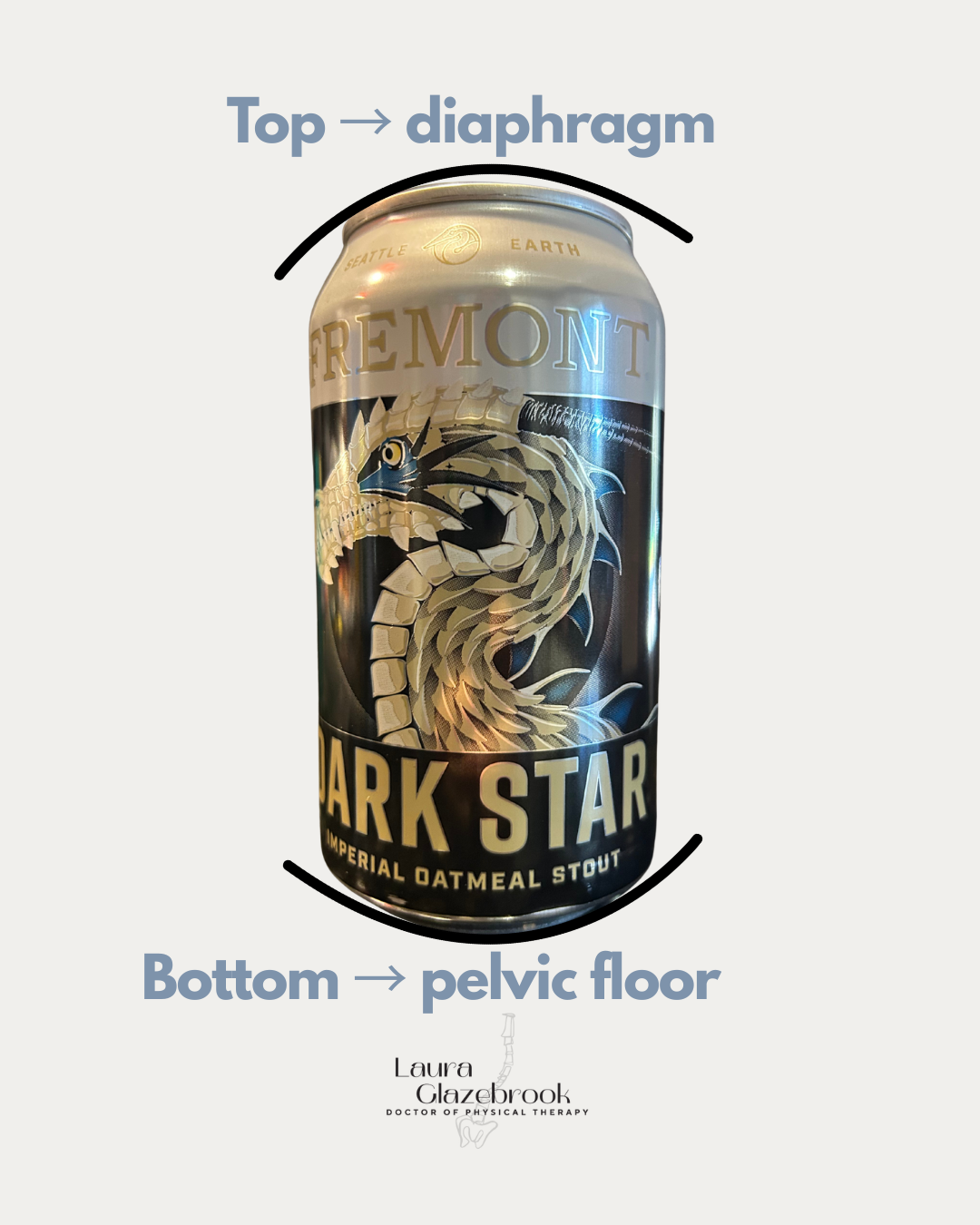
If you read part 1 of this blog, you may remember this image.
When we can learn to harness our breath appropriately, the diaphragm and pelvic floor actually move together, preferably without you even having to think about it. The relationship was designed to be automatic. (Remember, I have a whole blog specifically on this relationship that you can read here, in case you haven’t!)
All of that said, while it is a useful strategy, it shouldn’t be the only one! Constantly increasing load without other support could lead to overwork of the pelvic floor muscles, which may be one mechanism behind why people with joint hypermobility and EDS are more prone to pelvic girdle pain.
In fact, we can harness the power of our breath by training our pelvic floor and core to work in concert with our exhalation.
A note on pressure management
Just as important as a well-coordinated core, being able to successfully manage our pressures is critical for our long-term pelvic health. Refer to Part 1 of this blog for a refresher on the typical mechanics of the core and pelvic floor.
Frequently, people who struggle with finding stability with strenuous tasks or movements tend to strain or bear down when lifting or other challenging activities. This can absolutely be a useful stability strategy occasionally, but if you think about it over time, consistently bearing down can lead to (at best) overburdening an already overworking pelvic floor and creating more tension, to (at worst) an environment where the pelvic floor becomes painful or we are more at risk of pelvic organ prolapse. There is some evidence to suggest people with joint hypermobility have a larger prevalence of pelvic organ prolapse. Learning how to manage pressure well can serve our pelvic health for life!
Think of the pelvic floor as a mirror to the diaphragm, or our primary breathing muscle. If we can train our pelvic floor to contract when we exhale, it can help create more strength and stability in our core as we work on managing those heavier loads or pressures. Once we find this rhythm, it becomes much easier to add challenge, work on speed or add movement.
Check out the video below for a real world example:
Strength gain differences in a hypermobile body
Slow strength wins
Though there aren’t a ton of studies directly investigating this, many people with hypermobility find that it feels harder to build muscular strength, or that it takes a longer time, than some of their peers. A 2009 study determined 85% of their participants with EDS reported up to moderate muscle weakness, and a 2021 study showed that up to 80% of participants suffered from exercise intolerance or dysautonomia.
Though the research in this area is still slim, I’m sure you can gather from the two paper findings above that people living with hypermobility may have some additional barriers when it comes to building muscle strength.
Plyometric (or power-based), fast exercises may feel too challenging, at least initially, as you’re starting out. Starting with slower, more controlled movement can help us build muscular stability and strength in a mid-range that can prepare us for success for these bigger or more challenging movements. Building strength in the right way can absolutely lower the tension or strain in our postural muscles — like our pelvic floor! — to help us feel stronger and more stable.
Key Muscles to Strengthen
As you’ve seen me say repeatedly, the pelvic floor is part of a system, and that system can be supported — or hindered — by the support of many other muscles that help stabilize us.
A quick list:
The glutes and hip stabilizer muscles
The core and spinal stabilizers muscles
The shoulder blade muscles
Believe it or not, when we focus on creating strength in the groups listed above, it can help us move easier and feel better.
Below are some exercises that can target all the above groups:
Glutes (hip extensors)
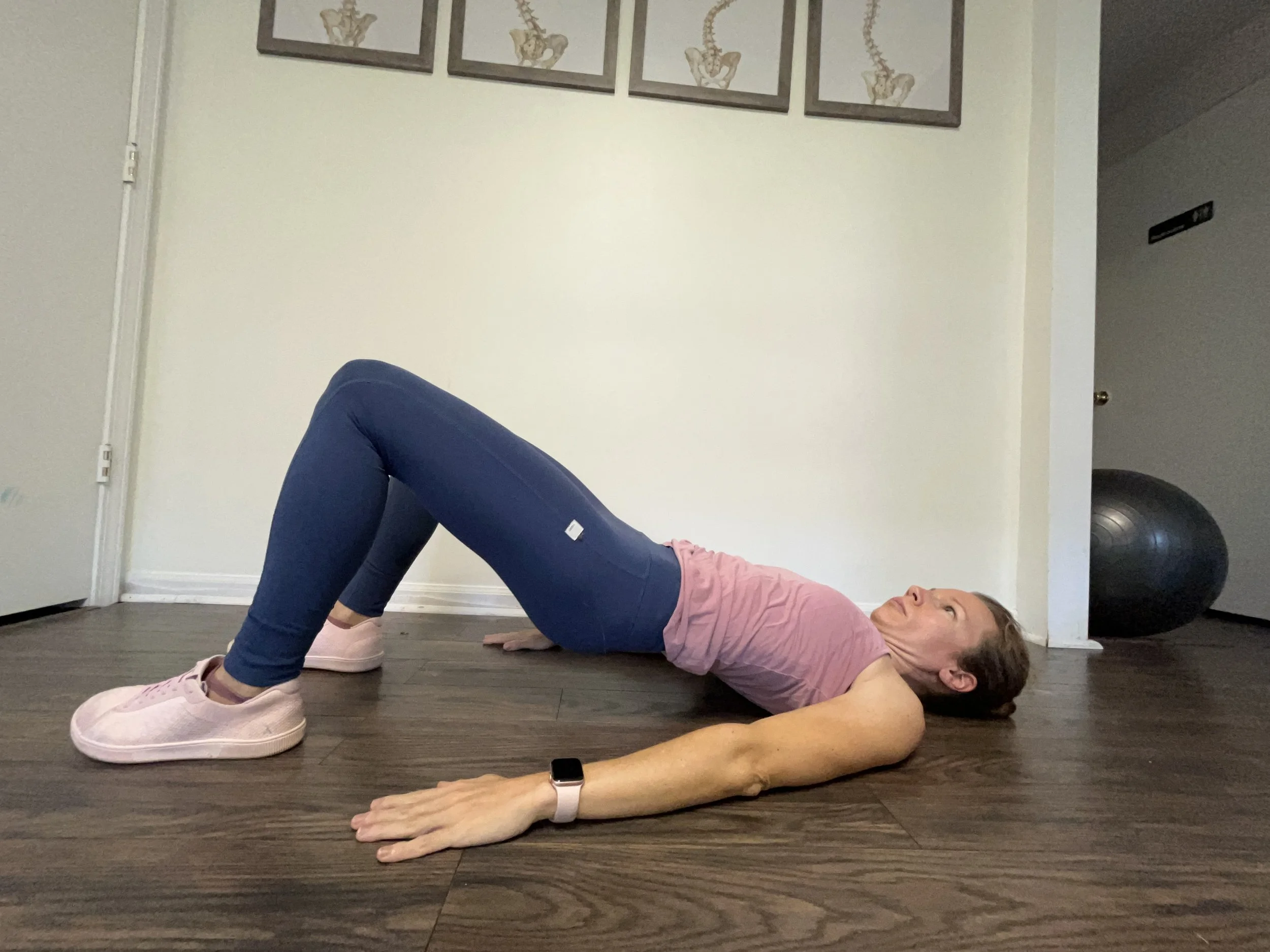
This standard glute bridge is a great option to create some good work in the back of the hips. Make sure to take a deep breath, engaging your core and pelvic floor as you lift for optimal effect!
You can also add a march while in a bridge position, or do a single leg bridge with the other leg crossed over.

You can progress this exercise by adding a small exercise ball under the shins or heels and bridging from there.
Bonus points if you hold the bridge and pull your heels toward your butt to strengthen your hamstrings!

A basic hip extension from all fours is also a nice option to activate the glute muscles. Make sure you’re keeping the core slightly engaged to avoid excessive sway at the hips or low back.
Core stabilizer muscles
There are so many variations of core exercises to incorporate into your pelvic health program, including but not limited to:
Dead bugs
Regular planks and forearm planks
Side planks
But my all time favorite plank is the quadruped, or all fours, plank pictured below:
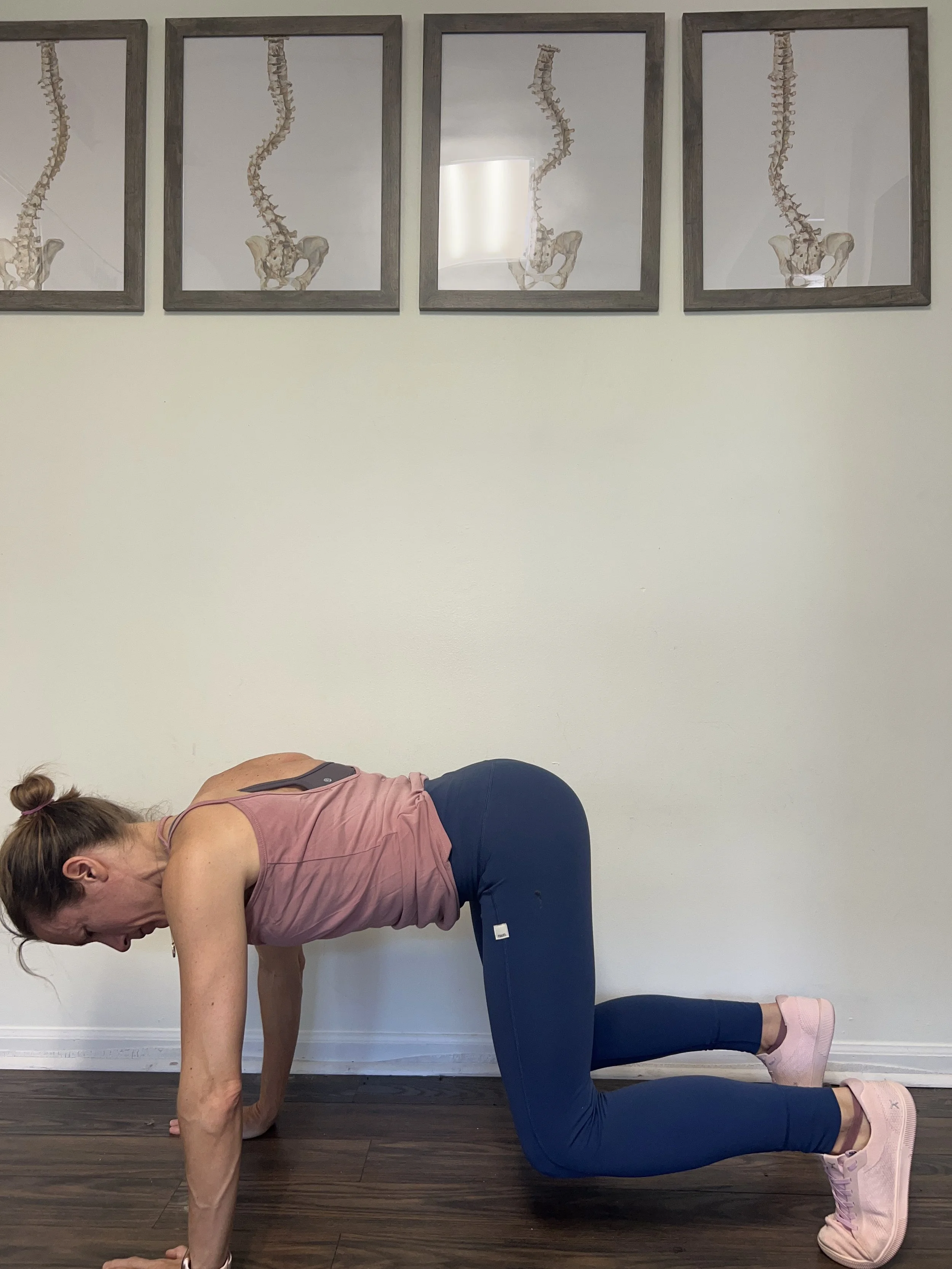
It’s much harder than it looks! Keeping the core engaged and the hips stable, you can simply hold the position, OR you can add marching of the hands or feet, or even a bear crawl!
Shoulder blade muscles
This one doesn’t feel as straight forward, but trust me: having a strong set of shoulders can help provide stability to our head, neck and mid-back, which is particularly important given the suggestion people with hypermobility also have a degree of cervical instability. A few examples of some great shoulder blade exercises are:
Push ups of all varieties, from easiest to most challenging:
Wall push ups (pictured below) — hands on the wall with feet out
Bench push ups — hands on elevated platform or bench
Standard push ups — hands or forearms on the floor
Decline push ups — feet elevated on a bench or platform
Wall angels — standing up against a wall, allow the back of your arms to slide down toward your sides
Rows and lat pull downs

Here’s a version of a wall push up!
What NOT to do
Starting with big, fast movements
Moving through the full range without feeling stable in the middle first
Workouts that cause breath-holding or straining
Constantly gripping in:
The pelvic floor
The abdominals or other core muscles
The jaw (yes, you can use your jaw to stabilize without even being aware of it!)
Adding resistance or heavier weights too quickly
Simple daily exercises to support your pelvic floor with hypermobility
More often than not, we need to allow the pelvic floor to lengthen, or release, than do more traditional kegel type exercises. (In fact, I have a whole blog on the truth about kegels and why I don’t recommend them, you should read it if you’ve ever questioned!)
Below are some of my go-to pelvic floor release and lengthening exercises, if this seems like a foreign concept:
If you have access to a few different sized exercise balls, they can really help create an environment where you’re better able to release the pelvic floor muscles.
Below are two of my favorite easy release techniques with a Pilates ball as well as a larger exercise ball.
Sometimes what your pelvic floor really needs is permission to release, lengthen and move in natural rhythm with the rest of your core muscles. Additionally, our core muscles work at their best when they are coordinated and working together (read: coordination > brute strength, any day of the week. Particularly with hypermobility.)
In my expert opinion, the vast majority of us with hypermobility and pelvic floor concerns need to learn how to lengthen and contract those muscles along the full range before we do anything else!
When to seek help
If you’re doing all of the above and still having a hard time, you may need additional support — which isn’t a bad thing! There are people like me all around the world, ready and able to help you get the results you crave.
Some signs and symptoms that you may want to seek professional help include if you’re experiencing:
Pelvic heaviness, or sensations of chronic deep pelvic or low back tension
Pain with intimacy or surrounding bowel movements
Chronic low back, deep hip or pelvic pain that could indicate pelvic floor dysfunction
Feeling unstable or unsteady during workouts, or significant pain following workouts
If any of these feel familiar, you may want to reach out to a local pelvic floor specialist who can help create a plan specifically for you. Make sure your provider has experience in hypermobility syndromes if you can before scheduling.
You can also work with me virtually from anywhere in the world! If you don’t have access to a local specialist, you’d be amazed at what we can accomplish during virtual visits. I’m also happy to answer any questions if you email me.
More hypermobility resources for you
I’m a big fan of connecting people with other professionals who work in this space and have created resources. That said, here are two of my go-to colleagues who can also guide you as you navigate finding strength and stability in your hypermobile body:
Dr. Melissa Koehl of Chimera Health
Dr. Melissa is a Doctor of Physical Therapy, Pilates instructor, and specialist in symptomatic hypermobility. Combining 25 years of clinical experience with her own lived experience, she helps people reduce pain, build strength and improve stability through evidence-based education and exercise. She offers free resources, online group programs, and self-paced courses designed specifically for hypermobile bodies. Check out her offerings here.
Dr. Kate Bacigalupo & The Elements Collective
The Elements Collective’s Elevated Elements Program is a 12-week virtual coaching program for hypermobile humans navigating chronic pain, dysautonomia, fatigue and other complex chronic conditions. Through personalized movement programming, education, nervous system support, and asynchronous coaching, we help people better understand their bodies and build sustainable capacity over time. Check the program out here.
Let them know I sent you if you reach out to them!
Final encouragement
Your body may be extra bendy, but there is so much you can do to support yourself, building sustainable strength and a healthy pelvic floor.
You can build strength & control with time, the right routine and strategies.
Small, steady practice over time creates big change that can really make a difference in how your body feels every day.
You deserve support that understands both the pelvic floor and hypermobility! There are so many resources at your disposal, including me and my two aforementioned colleagues, who can help you find your bearings.
Next steps
You may be interested in the following blogs:
Not able to find or access a pelvic floor therapist? I created a free guide to assess your own pelvic floor muscles.
Note: While this is not a substitute for pelvic floor therapy, it does give you some insight as to where you are now and some guidance on what should be happening.
If you are needing more clarification or have specific questions you can always send me an email. And, as always, you can book a virtual consult with me to get expert advice on your situation from anywhere in the world, from the comfort of your own home.
Sources:
Veit-Rubin N, Cartwright R, Singh AU, Digesu GA, Fernando R, Khullar V. Association between joint hypermobility and pelvic organ prolapse in women: a systematic review and meta-analysis. Int Urogynecol J. 2016;27(10):1469-1478. doi:10.1007/s00192-015-2896-1
Abaza I, Tadros M, Lemmon B, Bhide A, Fernando R, Khullar V. Joint hypermobility syndrome for the urogynaecologist - A narrative review. Eur J Obstet Gynecol Reprod Biol. 2026;318:114943. doi:10.1016/j.ejogrb.2026.114943
Ali A, Andrzejowski P, Kanakaris NK, Giannoudis PV. Pelvic Girdle Pain, Hypermobility Spectrum Disorder and Hypermobility-Type Ehlers-Danlos Syndrome: A Narrative Literature Review. J Clin Med. 2020;9(12):3992. Published 2020 Dec 9. doi:10.3390/jcm9123992
Voermans NC, van Alfen N, Pillen S, et al. Neuromuscular involvement in various types of Ehlers-Danlos syndrome. Ann Neurol. 2009;65(6):687-697. doi:10.1002/ana.21643
Marathe N, Lohkamp LN, Fehlings MG. Spinal manifestations of Ehlers-Danlos syndrome: a scoping review. J Neurosurg Spine. 2022;37(6):783-793. Published 2022 Aug 19. doi:10.3171/2022.6.SPINE211011